
Rich County Arrest Court Records
In Rich County, a jail arrest and a court record are linked but not identical. Booking is the sheriff or jail step. It records that a person entered custody, what agency brought the person in, and what alleged offense was tied to the arrest. The court record begins when a prosecutor files a charging document or when a citation or case is accepted by the court. Formal charges may match the booking allegation, but they may also change after review.
The local path is simple because Rich County has one small county jail and a limited court structure. Justice Court handles many local matters, while District Court handles felony and higher-level district cases. County Attorney Benjamin Willoughby is the local prosecutor named by the county, and the county attorney page says the office prosecutes felony criminal matters. For custody and booking details, use Rich County jail inmate records. For booking photos, use the separate Rich County jail mugshots page.
Process: Arrest leads to booking, booking leads to prosecutor review, filed charges create the court record, and the court record tracks the case outcome.
Rich County Court Contacts
The Rich County Courts page is the local doorway for court dates, clerks, citations, and hearing scheduling. Rich County Justice Court lists P.O. Box 218, Randolph, UT 84064, phone (435) 793-2415, fax (435) 793-2410, Judge Trevor L. Cook, and Justice Court Deputy Clerk Shantel Jensen. The county page says Justice Court generally meets on the first Tuesday of each month, subject to change.
District Court is listed at the Rich County Courthouse, 20 South Main, Randolph, UT 84064, with main telephone (435) 793-2415 and main fax (435) 793-2410. The page names Administrative Assistant Gabrielle Bremner for First District Court, Judge A. Fonnesbeck, and Court Deputy Clerk Shantel Jensen. If a citation or ticket does not appear in the county citation payment search after 5 days from the citation date, the county court page says to contact the court at (435) 793-2415.
The county's court contact page is shown in the official screenshot from Rich County Courts.
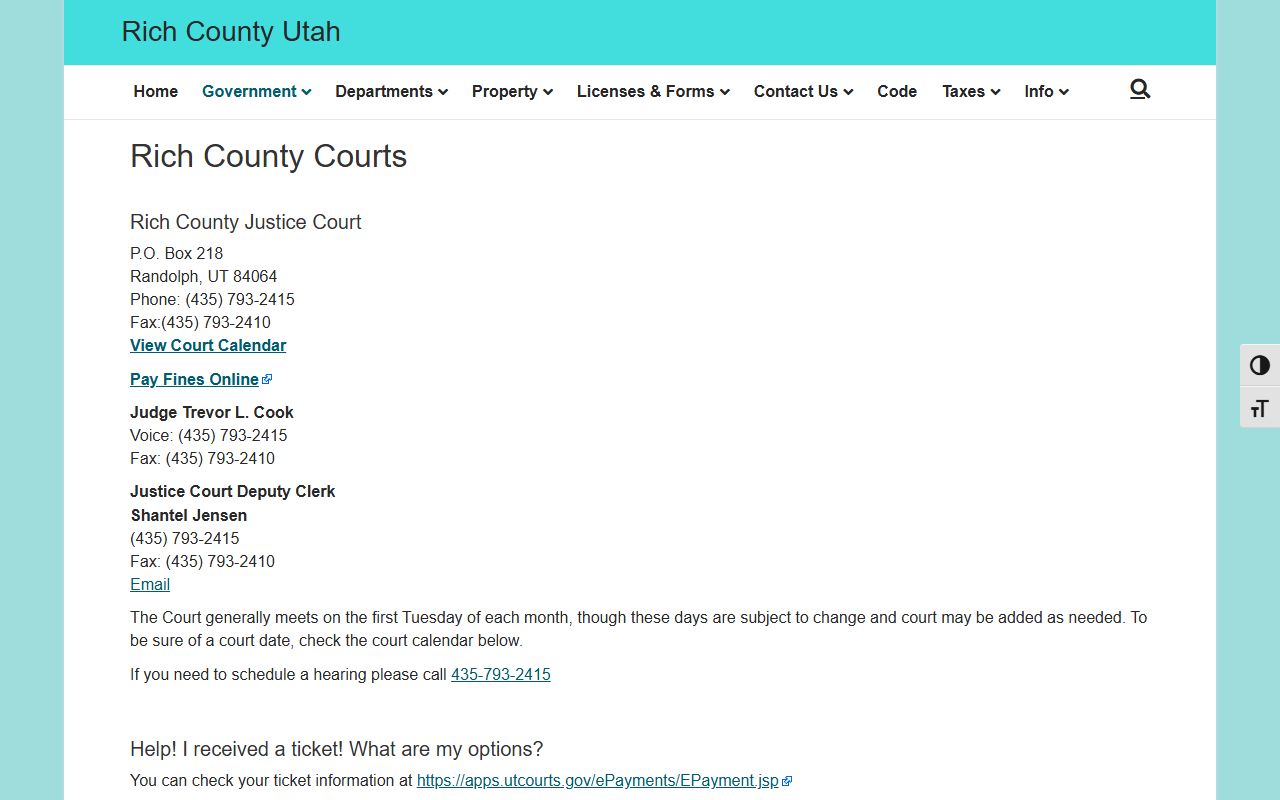
That local court page matters because Rich County court records after arrest often turn on hearing dates, citation timing, and which court has the case.
Search Rich County Court Records
Utah Courts Xchange is the public statewide case-search channel for Rich County criminal cases after filing. The Utah Courts Xchange information page says Xchange provides summary case information such as party names, assigned judges, attorneys of record, documents filed, hearings held, judgments entered, and completed-case outcomes. It also says public document images filed in district court cases may be available for purchase through Xchange.
- Start with the Xchange portal when the question is whether Rich County charges have been filed.
- Search with the defendant name or case number if one is known from a citation, jail record, or clerk notice.
- Open the case summary and compare the charge list with any booking or citation details.
- Check hearings, assigned judge, disposition, and each charge status before relying on an old arrest allegation.
MyCase is different. The Utah Courts MyCase page describes party access to case history, filed papers, payments, and linked Utah Courts cases at no fee. A member of the public usually starts with Xchange, while a party may have a broader view through MyCase. Neither portal replaces the Rich County court clerk for hearing scheduling or local citation issues.
| Field Label | Type | Required | Notes |
|---|---|---|---|
| Username | Text | Required for account login | Visible on the Xchange login page. |
| Password | Password | Required for account login | Used for account access. |
| Captcha text | Text | Required | Xchange requires captcha and JavaScript. |
| Guest/search fields | Dynamic | Not captured | The public search interface is JavaScript-driven. |
The Xchange public case portal appears in the captured image from Utah Courts Xchange.
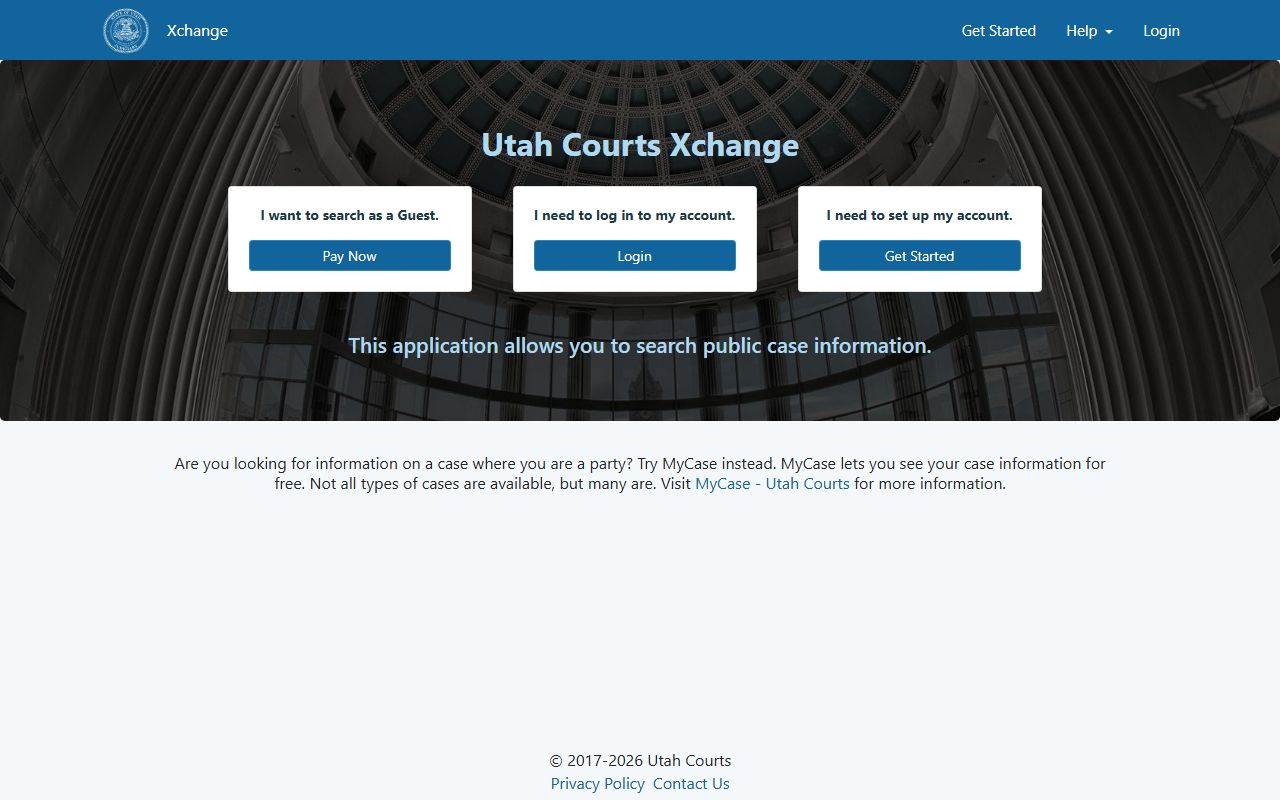
Xchange is useful after filing, but a recent arrest may still be too new for a complete court record.
Rich County Charge Records
Charge records begin with a formal filing, not with a rumor or a roster note. A law-enforcement report can list suspected offenses at booking, but the prosecutor reviews reports, witness information, citations, and evidence before deciding what to file. In felony matters, the Rich County Attorney's Office is the prosecution office named by the county. The local attorney listing gives Benjamin Willoughby, P.O. Box 402, Randolph, UT 84064, and phone numbers (435) 793-2100 and (435) 793-2410.
Three filing labels come up often. The exact document type depends on court, offense level, and procedure, so the case entry is the better source than a booking note. A complaint or information can open a case after arrest, while an indictment is tied to grand jury action.
| Document | Who Files It | Common Use | What It Starts |
|---|---|---|---|
| Complaint | Officer or prosecutor | Often used to begin criminal or citation-based proceedings | A court case or first formal charge entry |
| Information | Prosecutor | Common route for many felony prosecutions after review | Formal prosecution in the assigned court |
| Indictment | Grand jury | Serious matters when grand jury charging is used | A criminal case based on grand jury accusation |
Rich County Charge Status
Charge status keeps a Rich County arrest from being frozen in time. A person may be booked on one offense, charged with another, or have a charge amended after plea talks or further review. Dismissal of one count does not always end the whole case, and a pending charge is not a conviction.
| Status | Meaning in the Court Record | Reader Caution |
|---|---|---|
| Pending | The charge is filed and unresolved. | Do not treat it as a conviction. |
| Amended | The filed charge, level, or wording changed. | Compare the newest entry to the original filing. |
| Reduced | The charge level or offense was lowered. | The final plea or judgment may differ from booking. |
| Dismissed | The court or prosecutor ended that count. | Check whether other counts remain open. |
| Convicted | A plea or finding resulted in guilt. | Review sentence, fine, probation, and closure terms. |
Utah GRAMA also shapes access to records. Utah Code 63G-2-201 provides access to public records subject to limits, while Utah Code 63G-2-204 requires a written request with enough detail to identify the record. Rich County's sheriff records process also requires photo ID and agency review for many releases.
Rich County Warrants and Bail
A warrant can be the reason a Rich County arrest occurred, or it can be issued later if a defendant misses court or fails to comply. No local Rich County active warrant list was found on the official county site. The official statewide route is the Utah Statewide Warrants portal, and the Utah DPS/BCI warrant page describes it as a free search of the statewide warrants file.
Bail and pretrial release terms also belong with the court record after arrest. Utah Code 77-20-102 defines bail, monetary bail, pretrial release, pretrial status order, and surety. Rich County does not publish a jail-specific bond payment page in the official sources reviewed. Call the jail or court to confirm whether a release order exists and whether another hold or detainer blocks release.
| Release Term | How It Works | Rich County Checkpoint |
|---|---|---|
| Own recognizance or PR | Release based on a promise and conditions, without money posted. | Confirm terms with the court or jail. |
| Cash or monetary bail | A financial condition set by court order. | Ask where payment is accepted before appearing. |
| Surety bond | A bail bond agency posts under Utah law. | Confirm that a bond is allowed and still current. |
| No-bond hold | Payment alone will not cause release. | A new order or cleared hold may be needed. |
| Detainer | Another agency or jurisdiction requests continued custody. | Ask whether the hold is local, state, federal, or immigration-related. |
Note: Citation payment instructions are not the same thing as a jail bond process, so verify bond, warrant, and hearing terms with the court or jail.
Rich County Charge Comparisons
A filed charge means the government has made an accusation in court. A conviction means the case reached a guilty plea, guilty finding, or comparable final result for that count. This distinction matters because a roster, warrant, or early filing may show suspected conduct before the case is resolved.
| Point | Charge | Conviction |
|---|---|---|
| Case stage | An accusation filed or listed in court. | A final guilt result by plea or finding. |
| Proof level | Based on filing standards and probable cause. | Requires proof beyond a reasonable doubt or a valid plea. |
| Can change | May be amended, reduced, or dismissed. | Usually changes only through later court relief. |
| Use in lookup | Shows what the prosecutor alleged. | Shows the outcome for that count. |
Rich County Sealed Court Records
Some Rich County court records after an arrest may later be restricted from normal public view. Expungement is the Utah process that seals or restricts qualifying criminal records from public inspection. Utah Code 77-40a-302 addresses certificate eligibility for arrest, investigation, and detention records. Utah Code 77-40a-303 addresses certificate eligibility for conviction records.
Sealing and expungement should not be treated as automatic. Eligibility depends on the case result, offense history, waiting periods, and Utah procedure. Even when public access is limited, courts, law enforcement, or other authorized users may retain access under law.
| Point | Sealed | Expunged |
|---|---|---|
| Public visibility | Hidden or restricted from routine public inspection. | Restricted through Utah's expungement process when eligible. |
| Agency access | May remain available to authorized users. | May remain available in limited statutory settings. |
| Best source | Court order and clerk status. | Certificate eligibility and court order. |
| Not automatic | Usually requires a legal basis or order. | Requires eligibility and proper filing. |
Important: Public case lookup is not a consumer report and should not be used for employment, housing, credit, insurance, or other FCRA-covered screening.